
This article provides an informational overview of Garage2Global App Development for Startups based on publicly available information and general startup app development best practices.
Starting a new app can feel exciting, yet the path from a clever idea to a successful product isn’t always simple. Garage2Global App Development for Startups aims to help new businesses turn concepts into practical digital products through planning, design, development, and launch support. Whether you want to build a mobile app for iOS, Android, or both, choosing the right technology partner can shape your budget, timeline, and future growth.
With the right startup app development strategy, you can focus on solving real customer problems instead of getting lost in technical complexity. This guide explores mobile app development for startups, key development stages, costs, challenges, and factors to consider before choosing a development partner.
5 Important Facts About Garage2Global App Development for Startups
What Is Garage2Global App Development and How Does It Work?
At its core, Garage2Global app development refers to services designed to turn a startup or business idea into a working mobile product. Garage2Global’s published mobile development page describes services covering custom apps, UI/UX, APIs, scalable architecture, publishing, and post-launch support. The company also says it works with both startups and established businesses.
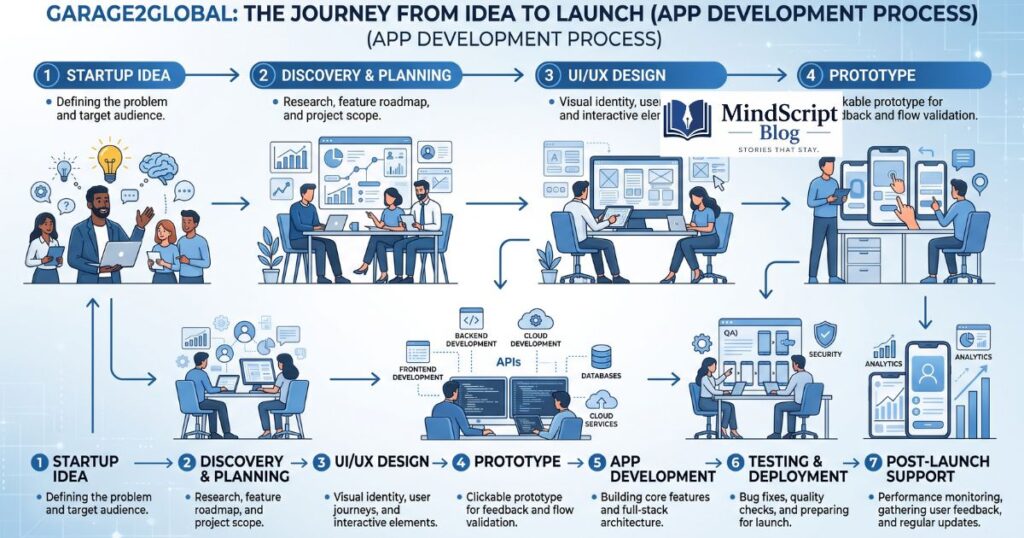
For founders, how Garage2Global app development works can be viewed as a journey from idea discovery to launch. You begin by explaining your audience, business model, and core problem. The team can then shape requirements, create designs or prototypes, develop the product, test functionality, and prepare it for distribution. The exact workflow should always be confirmed directly with the provider because service scope can vary between projects.
What Does the Process Usually Include?

A typical mobile app development process involves research, requirements, product design, development, testing, deployment, and maintenance. Garage2Global’s published process emphasizes understanding the app idea and audience before moving toward prototypes and development. Its materials also mention publishing support for the App Store and Google Play.
| Development Stage | Main Startup Goal | Typical Output |
| Discovery | Define the problem | Project requirements |
| Planning | Set priorities | Development roadmap |
| Design | Shape the experience | UI/UX app design |
| Prototyping | Test the concept | mobile app prototype |
| Development | Build core features | Working application |
| Testing | Find problems | Quality-tested release |
| Launch | Reach customers | Store-ready app |
| Support | Improve the product | Updates and maintenance |
Why Choose Garage2Global for Startup App Development?
Choosing an app development company is a major decision because your technology partner can influence product quality, speed, and future scalability. Garage2Global presents itself as a startup-friendly provider offering custom development, scalable architecture, security-focused solutions, and ongoing support. Its published mobile development material also highlights structured milestones, app-store optimization, and post-launch assistance.
Still, choosing an app development partner should involve more than reading service pages. Ask for relevant examples, development methodologies, communication processes, ownership terms, and maintenance policies. A good partner should understand your business objectives instead of merely building a list of requested features. The best relationship feels less like ordering software and more like building a product together.
What Should Startups Look For?
When searching for the best app development company for startups, focus on practical evidence. Review relevant portfolios, technical capabilities, communication quality, estimated timelines, and post-launch services. You should also confirm who owns the source code, designs, cloud accounts, domains, and intellectual property after delivery.
A startup technology partner should also understand MVP thinking. Your first release doesn’t need every imaginable feature. Instead, MVP development should focus on the smallest useful product that can test your central business assumption. That approach can reduce waste while giving you real user feedback before larger investments.
Garage2Global App Development Process: Step-by-Step Guide
The Garage2Global app development process should begin with clarity rather than coding. First, define the customer problem and explain why users would choose your solution. Then identify essential features, user flows, platform requirements, integrations, and business goals. This foundation creates a practical app development strategy before technical work begins.
Next comes design and development. The product team can transform requirements into wireframes and visual designs before developers build the frontend, backend, database, and integrations. After development, app testing checks functionality, compatibility, performance, and security. Finally, the team prepares app deployment, store submissions, analytics, and post-launch improvements.
Startup App Development Process Step by Step
A strong startup app development process step by step approach usually moves through discovery, validation, design, MVP development, testing, launch, and iteration. Each stage should have a clear deliverable and approval point. That structure helps founders control scope while keeping the product aligned with customer needs.
| Phase | Key Question | Startup Decision |
| Discovery | What problem are we solving? | Define the product |
| Validation | Do users need it? | Test market demand |
| Planning | What should launch first? | Prioritize MVP features |
| Design | How will users interact? | Approve user flows |
| Development | How will it work? | Build the product |
| Testing | Does it work reliably? | Fix critical issues |
| Launch | Can customers use it? | Release publicly |
| Growth | What should improve? | Analyze and iterate |
iOS and Android App Development With Garage2Global
Platform selection can shape your budget, development timeline, and audience reach. Garage2Global iOS app development and Garage2Global Android app development are presented as options for businesses that want dedicated mobile experiences. Its published materials also describe custom iOS and Android solutions alongside cross-platform approaches.
For startups, the choice between native and cross-platform development deserves careful thought. Native app development can provide deep platform integration and highly optimized experiences. Meanwhile, cross-platform mobile apps can help teams reach multiple operating systems with shared code. The right choice depends on performance needs, available talent, budget, and product complexity.
Native vs. Cross-Platform Development
If your product depends heavily on advanced device capabilities, native development may make sense. However, if speed and budget matter most, cross-platform development may offer a practical route. Discuss these trade-offs before committing to your startup technology stack.
| Approach | Best For | Main Consideration |
| iOS Native | Apple-focused products | Separate platform development |
| Android Native | Android-first products | Platform fragmentation |
| Cross-Platform | Broad early reach | Framework limitations |
| Hybrid/Web-Based | Simple use cases | Native experience may vary |
Garage2Global App Development Cost and Pricing Factors
One of the most important questions founders ask is how much does app development cost? There isn’t one universal answer. The Garage2Global app development cost will depend on features, platforms, design complexity, backend requirements, integrations, security, testing, and ongoing support. The company’s published mobile app page says pricing varies according to complexity, features, and platforms.
Your startup app development cost can also change dramatically depending on whether you build an MVP or a full product. A simple MVP with authentication and basic database functionality requires fewer resources than an app with real-time communication, payments, geolocation, AI, and complex dashboards. Ask for a detailed proposal that separates development, third-party services, publishing, hosting, and maintenance.
What Affects App Development Pricing?
The most useful way to estimate mobile app development pricing is to break the project into cost drivers. Platform count, feature complexity, backend architecture, design depth, and integration requirements can all influence the final quote. You should also consider the total cost of ownership beyond the initial launch.
| Cost Factor | Potential Impact |
| Platform Choice | One or multiple platforms |
| UI/UX Design | Simple or highly customized |
| Features | Basic or advanced functionality |
| Backend | Simple database or complex infrastructure |
| Integrations | APIs and third-party services |
| Security | Authentication and data protection |
| Testing | Device and performance coverage |
| Maintenance | Updates and technical support |
Garage2Global vs. Other App Development Companies
A Garage2Global vs other app development companies comparison should focus on evidence rather than marketing claims. Compare technical expertise, relevant portfolio work, communication, timelines, pricing structure, ownership terms, and support. You should also ask whether the team has experience with startups similar to yours.
When making an app development company comparison, don’t automatically choose the cheapest proposal. A low initial quote can become expensive when requirements change or post-launch support isn’t included. Instead, compare the complete package. Look at delivery quality, transparency, technical architecture, and the provider’s ability to support your product after launch.
A Practical Comparison Framework
| Evaluation Area | What to Ask |
| Experience | Have they built similar products? |
| Technology | Which stack suits your project? |
| Communication | How often will you receive updates? |
| Ownership | Who owns the source code? |
| Security | How is customer data protected? |
| Support | What happens after launch? |
| Pricing | What is included in the quote? |
| Scalability | Can the architecture support growth? |
Common Startup App Development Challenges and How to Solve Them
Every startup faces startup development challenges, especially when resources are limited. Common problems include unclear requirements, changing scope, unrealistic deadlines, technical debt, weak testing, and poor product-market fit. These issues can increase costs quickly if founders don’t identify them early.
The solution starts with disciplined planning. Define the MVP, prioritize features, establish acceptance criteria, and create a realistic development timeline. Keep communication frequent and document major decisions. Most importantly, test assumptions with real users before spending heavily on advanced features. A beautiful app cannot rescue a product that solves the wrong problem.
Common Risks and Solutions
| Challenge | Practical Solution |
| Unclear Scope | Create detailed requirements |
| Feature Creep | Protect the MVP |
| Budget Overruns | Use milestone-based planning |
| Poor UX | Test prototypes early |
| Security Risks | Apply security from the beginning |
| Slow Performance | Monitor architecture and APIs |
| Weak Adoption | Validate demand before launch |
Garage2Global Success Stories, Case Studies, and Track Record
When evaluating Garage2Global success stories, case studies, and track record, founders should separate independently verifiable evidence from promotional testimonials. Garage2Global’s published mobile app page includes customer testimonials and describes projects involving startups and businesses. However, the page does not provide enough independently verified information to treat every claimed result as a proven case study.
Therefore, ask the provider for specific mobile app case studies relevant to your industry. Ideally, you should see the original business challenge, development approach, technology choices, timeline, launch outcome, and measurable results. Client references can also provide valuable insight into communication, reliability, and support quality.
What Makes a Strong Case Study?
A credible startup app success story should explain more than the final product. It should show the problem, solution, measurable outcome, and lessons learned. For example, increased retention or reduced operational costs is more meaningful than simply saying an app looked impressive.
“The strongest app portfolio isn’t the one with the prettiest screenshots. It’s the one that proves measurable business value.”
That principle applies to every app development company you consider.
Is Garage2Global the Right App Development Partner for Your Startup?
The answer depends on your goals, budget, technical needs, and expectations. Garage2Global publicly offers mobile development services for startups and businesses. Its published services include iOS, Android, custom development, UI/UX, scalable architecture, publishing support, and ongoing maintenance.
If you’re asking is Garage2Global good for startups, don’t make the decision from one website alone. Request a project proposal and ask for relevant references. Clarify pricing, ownership, milestones, technology choices, security responsibilities, and post-launch support. Then compare that information with at least two other providers.
A Simple Decision Checklist
| Question | Why It Matters |
| Do they understand your users? | Product-market fit |
| Can they build your MVP? | Faster validation |
| Is the technology scalable? | Future growth |
| Is pricing transparent? | Budget control |
| Is ownership clear? | Protects your business |
| Is support available? | Long-term reliability |
| Can they meet your timeline? | Launch planning |
Future Trends in Startup and Mobile App Development
The future of mobile app development will likely involve deeper automation, smarter personalization, stronger security, and more connected experiences. AI app development is already changing how products deliver recommendations, automate tasks, analyze data, and interact with users. Startups can benefit from these capabilities when they solve genuine customer problems rather than adding AI merely for novelty.
Other emerging app development trends include cloud-native applications, low-code development, connected devices, and increasingly personalized user experiences. Cross-platform frameworks may continue helping startups launch efficiently. At the same time, privacy and security will become even more important as apps handle increasingly sensitive information.
What Startups Should Watch
Artificial intelligence, machine learning, automation, and personalized experiences may become standard parts of many digital products. However, technology should always follow business value. A startup doesn’t need every new trend. It needs the right technology to solve the right problem at the right stage of growth.
Final Thoughts on Garage2Global App Development for Startups
Building a successful startup application requires much more than writing code. You need a clear problem, thoughtful product strategy, strong UI/UX app design, reliable engineering, careful testing, and a realistic launch plan. Garage2Global presents a range of services aimed at helping startups and businesses move from app concepts toward mobile products.
Ultimately, Garage2Global app development for startups may be worth considering if its capabilities match your requirements and its proposal meets your expectations. Before committing, verify the portfolio, request references, clarify ownership, review the contract, and compare competing providers. The smartest startup decision isn’t simply finding someone who can build an app. It’s finding a partner who can help you build the right app, launch it responsibly, and improve it as your customers teach you what they actually need.
Frequently Asked Questions